Knee Pain: Why Your Knee May Not Be the Whole Problem
Knee pain has a way of making itself known. You may notice it going up or down stairs, getting out of a chair, squatting at the gym, running, hiking, or walking the golf course. Sometimes it begins after a specific injury. Other times, it seems to appear without a clear reason.
When your knee hurts, it is natural to focus on the knee itself. But one of the most important things to understand about knee pain is that where you feel pain is not always the only place contributing to the problem.
The knee sits between the hip and the foot and has to respond to forces coming from both directions. How your hip controls your leg, how your ankle moves, how your foot interacts with the ground, and how your trunk manages movement can all influence what happens at the knee.
That is why understanding knee pain often requires looking beyond the knee.
What Can Cause Knee Pain?
“Knee pain” is a broad description rather than a single diagnosis. Different tissues and movement patterns can contribute to symptoms.
Common causes or presentations include:
Patellofemoral pain, often felt around or behind the kneecap
Tendon irritation, including patellar or quadriceps tendon pain
Meniscus-related symptoms
Ligament injuries
Osteoarthritis and age-related joint changes
Muscle strains or overload
Pain following a change in activity, training volume, or intensity
Movement or strength deficits that repeatedly increase stress through the knee
Some people have a clear structural diagnosis. Others have knee pain without one specific tissue explaining the entire picture.
This distinction matters because successful treatment is rarely about treating an imaging result alone. It is about understanding what is limiting your movement and what your knee needs to tolerate the activities that matter to you.
Common Signs That Your Knee Is Not Moving or Loading Well
Knee problems do not always show up as constant pain. You may notice:
Pain with stairs
Discomfort during squats or lunges
Pain when running or hiking
Difficulty kneeling
Stiffness after sitting for a long period
Swelling after activity
Difficulty fully bending or straightening the knee
A sense of weakness or instability
Difficulty getting up from a low chair
Pain during or after golf, tennis, pickleball, or other recreational activities
A noticeable difference between your right and left sides
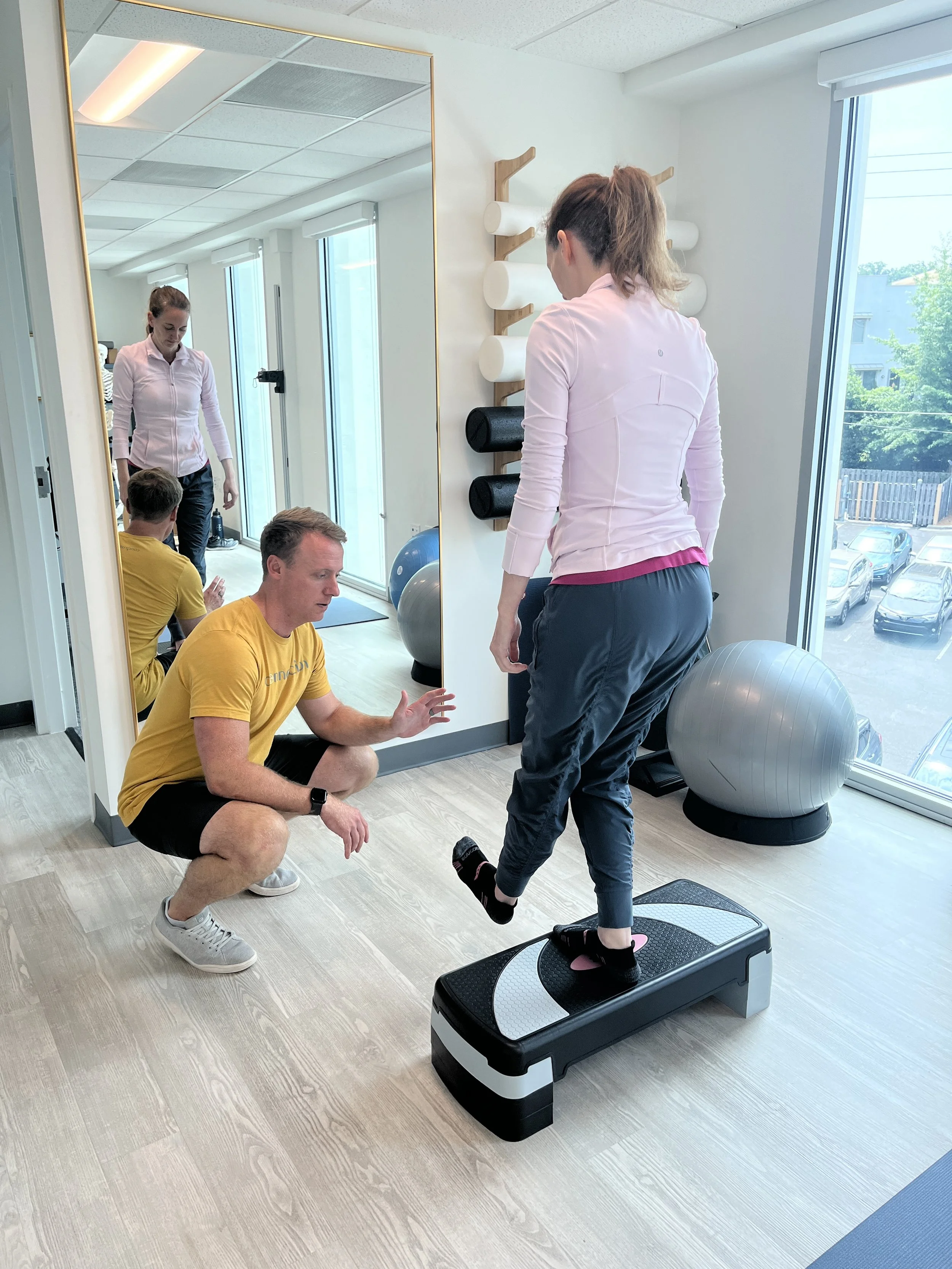
Sometimes people gradually begin changing how they move to avoid discomfort. You might put more weight through one leg, shorten your stride, stop bending the knee as deeply, or avoid an activity altogether.
Those adaptations can be useful temporarily, but over time they may contribute to additional movement compensations.
Why Does Knee Pain Keep Coming Back?
One of the most frustrating experiences is having knee pain improve with rest only to return as soon as you resume your normal activities.
This often happens because rest can calm symptoms without changing the reason the knee became overloaded in the first place.
Imagine that running three miles consistently irritates your knee. Taking two weeks off may make the knee feel considerably better. But if your strength, mobility, running mechanics, or tolerance for load have not changed, returning immediately to the same three-mile run may recreate the same problem.
This is where rehabilitation becomes less about simply decreasing pain and more about improving capacity.
Your knee needs to tolerate the demands you place on it. Those demands may include walking around the neighborhood in Myers Park, sitting and standing throughout a workday, lifting weights, playing 18 holes of golf, or training for your next race.
The goal is not simply to make the knee quiet. The goal is to help it become more capable.
Your Hip, Ankle, and Foot Matter Too
The knee does not function independently.
The Hip
The muscles surrounding the hip help control the position of the thigh and knee during walking, running, squatting, jumping, and changing direction.
If hip strength or control is limited, the knee may have to manage forces differently.
For people with patellofemoral pain, clinical practice guidelines published through the Journal of Orthopaedic & Sports Physical Therapy support exercise programs targeting both the hip and knee rather than focusing exclusively on the knee.
That does not mean every person with knee pain simply needs “stronger glutes.” It means the hip is one important part of a larger movement system.
The Ankle and Foot
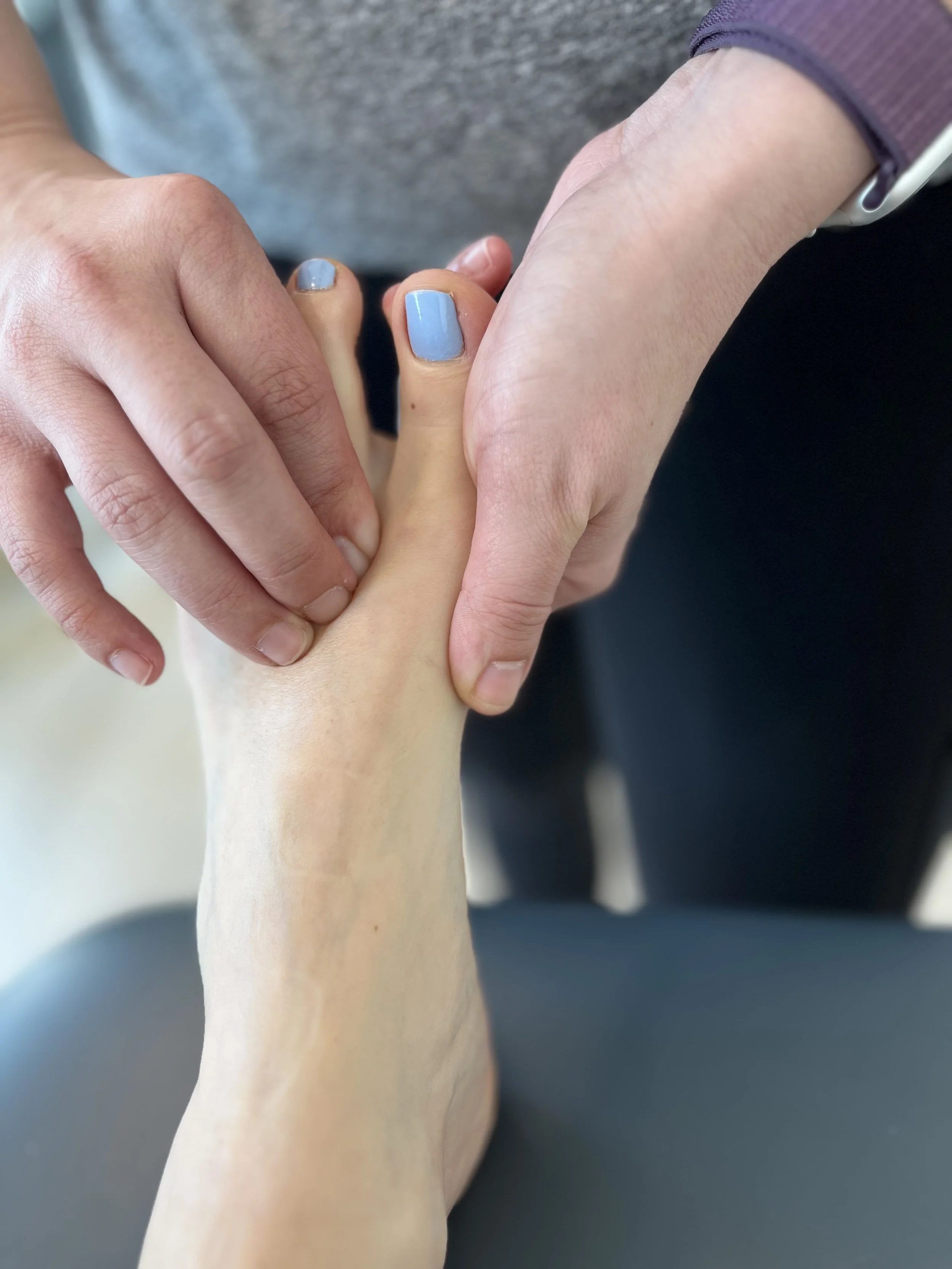
Your ankle needs enough mobility to allow your body to move over your foot when you walk, squat, descend stairs, or run.
If that motion is limited, your body will usually find another way to accomplish the task.
Sometimes that compensation occurs at the knee.
Foot mechanics can also influence how forces travel upward through the leg. This does not mean there is one “perfect” foot position. It means that your physical therapist should understand how your entire leg functions together rather than evaluating the knee in isolation.
Strength Is Important — but So Is Coordination
You can have strong muscles and still experience knee pain.
Why?
Because strength is only one part of movement.
Timing, coordination, balance, mobility, and your ability to control force all matter. A golfer, runner, recreational athlete, and someone who wants to comfortably climb stairs each place very different demands on the knee.
A physical therapy assessment should therefore consider not just whether a muscle is strong, but whether your body can use that strength effectively during the task that is giving you trouble.
This is especially important when returning to sports or higher-level activities.
The Role of Training Load and Recovery
Sometimes nothing is “wrong” with the knee in the traditional sense. It simply encountered more stress than it was prepared to tolerate.
Maybe you suddenly increased your running mileage.
Maybe you returned to tennis after several months away.
Maybe vacation involved significantly more walking and stairs than usual.
Or maybe your usual workout stayed the same while sleep, stress, recovery, or other demands changed.
The relationship between load and capacity is important.
Exercise is beneficial because appropriately dosed stress helps the body adapt. But when demand repeatedly exceeds what your tissues can currently tolerate, symptoms can develop.
Rehabilitation often involves finding the appropriate amount of movement rather than eliminating movement altogether.
Common Myths About Knee Pain
Myth #1: “If My Knee Hurts, I Should Stop Exercising.”
Sometimes modifying an activity temporarily makes sense. But complete rest is not automatically the best solution.
Exercise-based approaches are central to many evidence-based knee rehabilitation programs. Clinical practice guidelines from APTA Orthopedics and JOSPT emphasize exercise across multiple knee conditions, including patellofemoral pain and prevention of knee and ACL injuries.
The important question is not simply, “Should I exercise?”
It is, “What type and amount of exercise can my knee tolerate right now?”
Myth #2: “Knee Pain Means Something Is Damaged.”
Pain and tissue damage are not synonymous.
Pain is influenced by many factors, including tissue sensitivity, previous injury, movement, training load, recovery, and the nervous system.
Imaging can be useful in the right circumstances, but findings on an MRI or X-ray need to be interpreted alongside your symptoms, physical examination, and function.
Myth #3: “My Knees Are Just Bad.”
We hear variations of this frequently.
A history of knee pain, arthritis, surgery, or injury does not automatically mean that you have a “bad knee” that should no longer be challenged.
In many cases, the better question is: What does this knee need to do more comfortably, confidently, or efficiently?
That question gives us something useful to work toward.
Myth #4: “Squats Are Bad for Your Knees.”
Squatting is a normal human movement.
How deeply you squat, how much resistance you use, and how the exercise is programmed should match your current capacity. If squatting hurts, that does not necessarily mean you need to avoid it forever.
Sometimes the squat itself becomes part of rehabilitation.
What Does a Holistic Approach to Knee Pain Look Like?
At Congruency Therapy & Wellness, holistic physical therapy does not mean treating everything regardless of relevance.
It means looking broadly enough to understand what is actually influencing your problem.
For knee pain, that may include assessing:
Knee mobility
Hip and ankle mobility
Strength throughout the leg
Core and trunk control
Balance and coordination
Walking or running mechanics
Sport-specific movements
Previous injuries
Current exercise and training demands
Work and daily movement habits
Recovery and activity patterns
Someone seeking Charlotte physical therapy because their knee hurts after sitting all day may need a very different approach than an athlete preparing for competition.
Likewise, someone seeking Lake Norman physical therapy because knee pain is limiting golf or weekend activity around Davidson or Cornelius, NC may need rehabilitation that progressively recreates those demands.
The diagnosis matters. But the person attached to the diagnosis matters just as much.
When Should You See a Physical Therapist for Knee Pain?
You do not have to wait until knee pain becomes severe.
A physical therapy evaluation can be helpful if:
Pain keeps returning when you resume activity
Your knee is limiting exercise, recreation, or daily activities
You are changing how you walk or move because of discomfort
You have persistent stiffness or loss of motion
Your knee feels weak or unstable
You are unsure how to safely return to running, lifting, golf, or another activity
You have recovered from an injury but still do not trust the knee
You want to understand why the problem keeps recurring rather than continually resting it
A physical therapist can also help determine when symptoms do not appear musculoskeletal and another healthcare provider should be involved.
Moving Beyond the Knee
The knee may be where you feel the problem, but effective rehabilitation often starts by asking a bigger question:
What does your body need to do that it currently cannot do comfortably or efficiently?
Answering that question requires understanding the knee itself, the joints above and below it, and the way you move through your everyday life.
If golf is one of the activities affected by your knee, you can also learn more about Congruency’s Golf Performance services and how mobility, strength, and movement throughout the body influence the golf swing.
For some people, Dry Needling may also be incorporated into a broader physical therapy plan when clinically appropriate to address pain or muscular restrictions. It is one tool within treatment rather than a replacement for restoring movement and capacity.
If knee pain has started changing what you do—or how you do it—you can learn more on our Knee Pain Physical Therapy condition page or explore Congruency Therapy & Wellness’s broader physical therapy services in Charlotte and Lake Norman.
Claire Willis, PT, DPT