Neck Pain: Why It Happens, Why It Keeps Coming Back, and What Can Help
Neck pain has a way of affecting much more than your neck.
Maybe you notice stiffness when turning your head while driving. Perhaps sitting at your computer leaves you aching by the end of the day. You might wake up with tension that extends into your shoulders or experience headaches that seem to start at the base of your skull.
For some people, neck pain follows a specific injury. For others, it develops gradually without an obvious cause.
Either way, persistent neck pain often isn't simply a problem with one tight muscle or one part of your spine. Understanding what contributes to your symptoms—and how the rest of your body influences your neck—can be an important first step toward feeling and moving better.
Why Does Neck Pain Happen?
Your neck—also called the cervical spine—is made up of seven vertebrae surrounded by joints, muscles, connective tissue, nerves, and other structures.
It has two important jobs that sometimes compete with each other: it needs to be mobile enough to allow your head to move freely while remaining stable enough to support and control your head throughout the day.
Think about how often you use it.
You turn to back out of a parking space. Look down at your phone. Rotate during a golf swing. Look up during a workout. Spend hours moving between a computer and another screen.
The neck also doesn't perform these tasks alone. The upper back, rib cage, shoulders, shoulder blades, muscles, nervous system, and even breathing mechanics can influence how efficiently it moves.
Neck pain can develop when the demands being placed on this system exceed what it can comfortably tolerate.
Sometimes that happens suddenly, such as after an injury. Other times, the imbalance develops gradually.
Why Does My Neck Pain Keep Coming Back?
When neck pain returns, the painful area isn't necessarily the entire problem.
Imagine that your upper back isn't rotating particularly well. Your body still needs to turn, so you may create more of that movement through your neck.
Or perhaps your shoulder blade isn't moving efficiently when you lift your arm. Muscles connecting the shoulder blade to the neck may have to work harder to compensate.
The result may be neck tension—but repeatedly stretching the tight muscle doesn't necessarily change why it became overloaded in the first place.
Research also supports the importance of exercise as part of neck pain management, while suggesting that exercise doesn't need to look exactly the same for everyone. Studies examining chronic neck pain have found benefits from multiple types of exercise and emphasize matching rehabilitation to the individual's presentation and functional needs.
The important question isn't simply, "Where does it hurt?"
It's also, "What is asking this area to work harder than it should?"
Your Neck Is Part of a Larger Movement System
At Congruency, our holistic approach to physical therapy doesn't mean assuming that everything in your body is causing your neck pain. It means looking broadly enough to determine what is actually relevant. Several areas deserve consideration:
Your Upper Back and Rib Cage
Your cervical spine sits on top of your thoracic spine—the portion of your spine that runs through your upper and middle back.
Your upper back should be able to rotate and extend. Your rib cage also moves as you breathe and as your trunk rotates.
When those areas aren't moving efficiently, your neck may compensate.
For example, turning your head while driving isn't purely a neck movement. Your upper back contributes as well. If you aren't getting enough rotation through your thoracic spine, your cervical spine may have to create more of the motion.
Your Shoulders and Shoulder Blades
Your shoulder blades are another important part of the picture.
Several muscles connect your neck, upper back, and shoulder blades. These regions have to coordinate every time you reach overhead, pull, press, carry something, or exercise your upper body.
For an active adult, limited shoulder mobility or poor shoulder-blade control can change the demands placed on the neck during lifting.
For a desk worker, insufficient endurance may make it increasingly difficult for the muscles around the neck and shoulders to manage a long workday.
The symptoms may be similar, but the underlying movement demands are quite different.
Your Strength and Stability
Neck pain isn't always a mobility problem.
Sometimes an area that feels "tight" actually needs more stability.
If muscles become tired quickly, other areas may compensate. If you have plenty of range of motion but difficulty controlling it, gaining even more flexibility may not solve the problem.
Instead, the tightness may reflect underlying joint dysfunction or hypermobility. Further, that instability might be reducing nerve signals to other parts of your body.
Your Breathing Mechanics
Your diaphragm should do much of the work during relaxed breathing, but muscles around your neck and upper chest can also assist with breathing.
These are called accessory respiratory muscles.
Using them isn't inherently problematic. But if these muscles are consistently doing more work than necessary, they may contribute to tension around the neck and shoulders in some people.
That's one reason a whole-person movement assessment may occasionally include something as seemingly unrelated as how your rib cage moves when you breathe.
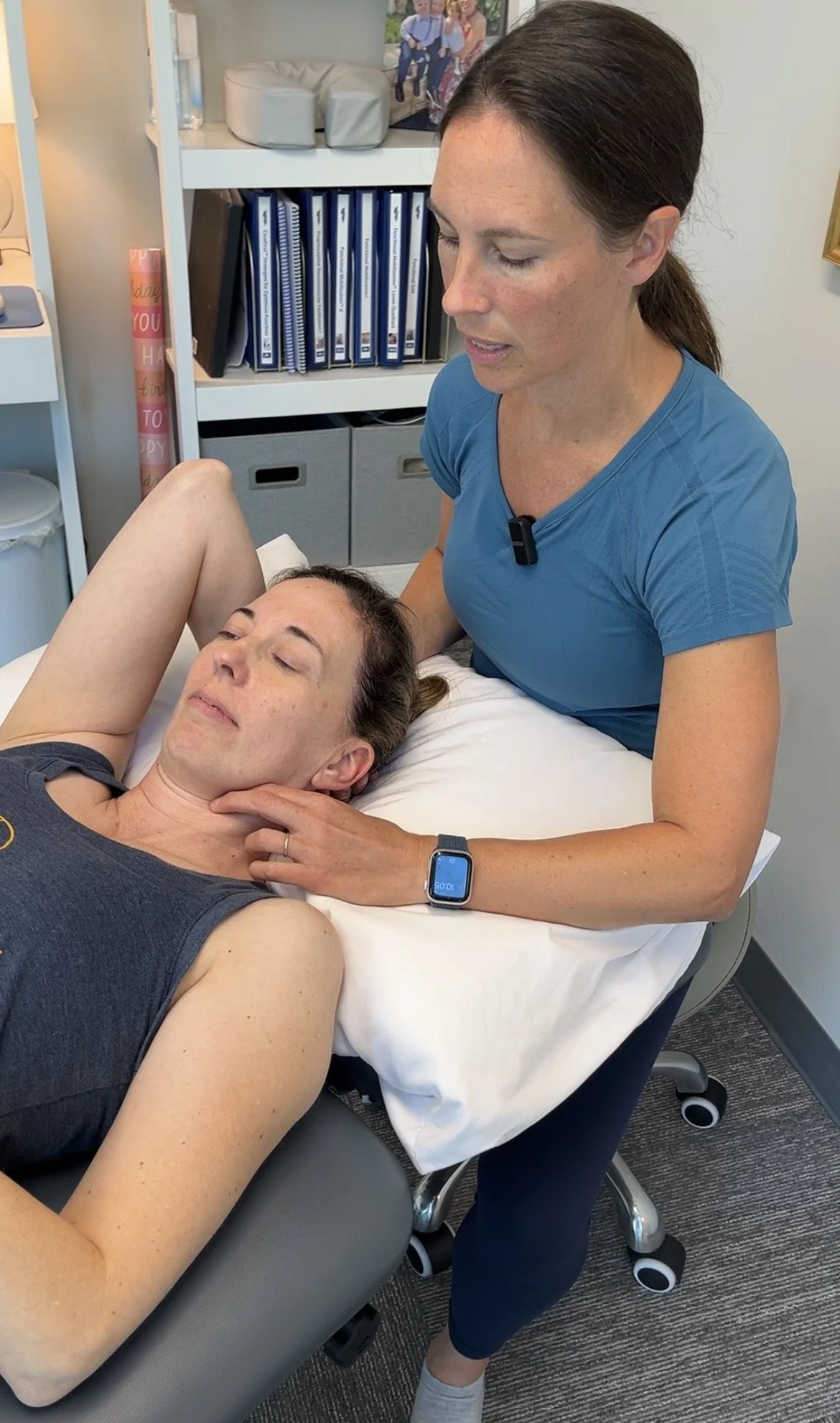
How Can Physical Therapy Help Neck Pain?
Physical therapy should be more specific than simply handing everyone with neck pain the same sheet of exercises.
A thorough evaluation may look at:
Neck mobility
Upper-back and rib-cage mobility
Shoulder movement
Shoulder-blade mechanics
Strength and muscular endurance
Movement coordination
Neural mobility
Breathing mechanics
Workstation and daily movement demands
Exercise or sport-specific movements
Treatment can then be built around what is actually relevant.
Hands-on treatment can create an opportunity to move differently, but rehabilitation should ultimately help your body build the strength, mobility, coordination, and capacity necessary to handle your real life.
When Should You Seek Help for Neck Pain?
Consider having your neck evaluated if:
Symptoms aren't improving as expected
Pain repeatedly gets better and then returns
You have difficulty turning your head
Neck pain interferes with sleep
You experience recurring headaches associated with your neck
Work or prolonged sitting consistently aggravates symptoms
You've stopped exercising or participating in activities because of your neck
You've tried stretching, massage, or self-treatment without lasting improvement
You're simply unsure what you should—or shouldn't—be doing
A physical therapist can also screen whether your symptoms appear appropriate for physical therapy or whether another healthcare provider should be involved.
If neck pain keeps interfering with the things you want to do, you can learn more about our approach. You can also explore how Functional Manual Therapy, Dry Needling and Myofascial Release may fit into an individualized treatment plan when appropriate.
Our goal isn't to chase symptoms. It's to understand the person experiencing them and help build a body that's better prepared for what comes next.
At Congruency Therapy & Wellness, we provide individualized Charlotte physical therapy and Lake Norman physical therapy for people who want to better understand how their bodies move and why symptoms may be occurring.
We work with clients throughout Charlotte—including Myers Park, Dilworth, Eastover, Cotswold, and SouthPark—as well as Cornelius, NC and surrounding Lake Norman communities such as Davidson, Huntersville, Denver, and Mooresville.
Meg Mizrachi, PT, DPT, OCS