Do You Have Shoulder Pain?
Do you have shoulder pain? We can help. For clients throughout Charlotte and Lake Norman — whether you're at a desk all day, working through a golf or tennis swing or routinely picking up children — shoulder pain has a way of limiting the things you want to keep doing.
We begin with a thorough evaluation looking at your overall posture, shoulder, cervical, and ribcage range of motion, and shoulder girdle strength, stability, and movement patterns. Frequently, shoulder pain does not require surgery — just good physical therapy rehab, which includes pain management, hands-on manual therapy, restoring mobility, neuromuscular re-education, and strength and stability training. If we do think you need to see a shoulder specialist, we will make the appropriate referral. We also see many clients post shoulder surgery.
Understanding the Shoulder: Built for Motion, Vulnerable to Imbalance
Your shoulder is primarily a ball-and-socket joint made up of three dominant bones — the humerus (arm bone), clavicle (collarbone), and scapula (shoulder blade). The key joints of the shoulder girdle are the sternoclavicular joint, acromioclavicular joint, glenohumeral joint, and the scapulothoracic joint. The shoulder joint has the most range of motion in the body, but that mobility is achieved at the expense of stability. The numerous shoulder muscles, tendons, ligaments and the shoulder capsule provide that stability. Everything must work together efficiently or problems develop.
Often, muscles and key structures get out of balance due to poor posturing (think: hours at a desk or hunched over a laptop), overuse (a repetitive golf or tennis swing), and/or faulty biomechanics — and injuries occur. This is especially true for hypermobile individuals, whose joints move through a larger range of motion but often rely more heavily on muscular control for stability.
Common Shoulder Conditions We Treat
The most common shoulder conditions we treat in our clinics include:
Impingement syndromes
Rotator cuff tears and repairs
Labral tears
Shoulder replacements
Adhesive capsulitis (frozen shoulder)
Thoracic outlet syndrome
Shoulder dislocations
Tendinitis and bursitis
When to Get Your Shoulder Evaluated
If you are having pain in your shoulder, or there is new clicking, popping, or a feeling of instability in your shoulder joint, it's best to get it evaluated to prevent further injury. This is particularly important for overhead athletes — golfers, tennis players, and pickleball players — whose shoulders are placed under repetitive load, and for hypermobile individuals, who may feel instability before they feel pain.
Our Approach to Shoulder Rehab
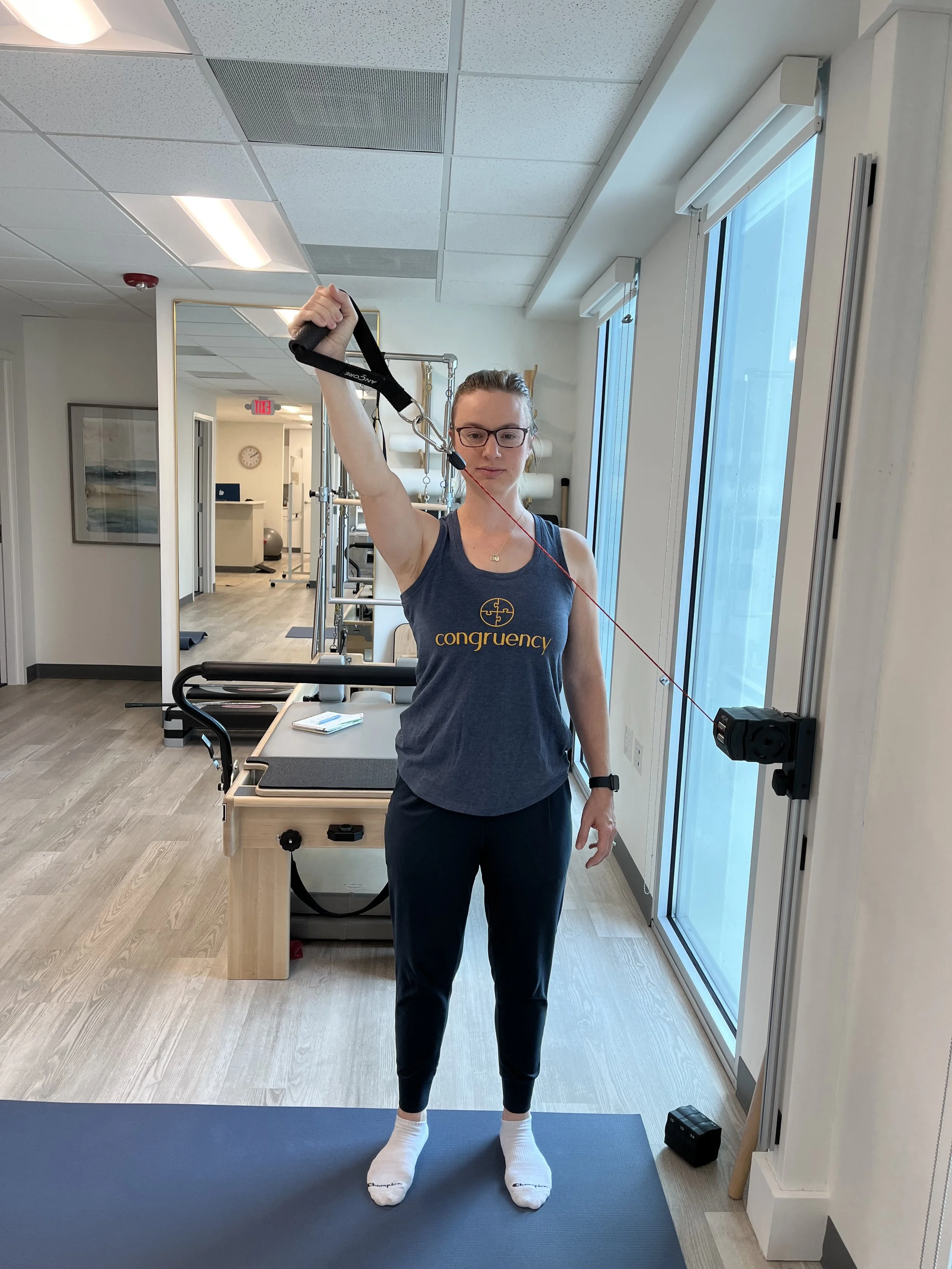
Effective management of shoulder pain involves a comprehensive approach: pain relief, manual therapy techniques, dry needling if appropriate, restoring mobility, strengthening the shoulder muscles, and restoring coordination and biomechanics so the joint moves the way it's meant to — not just symptom-free, but functioning well for the long term so injuries are less likely in the future.
Cay Moore, PT, PYT-c